The fifth event in the "Philosophy Gatherings at PAÜ" series, organized by the Department of Philosophy at the Faculty of Humanities and Social Sciences (İTBF) of Pamukkale University (PAÜ), was held with the participation of Assoc. Prof. Dr. Ceyhun Akın Cengiz from Manisa Celal Bayar University.
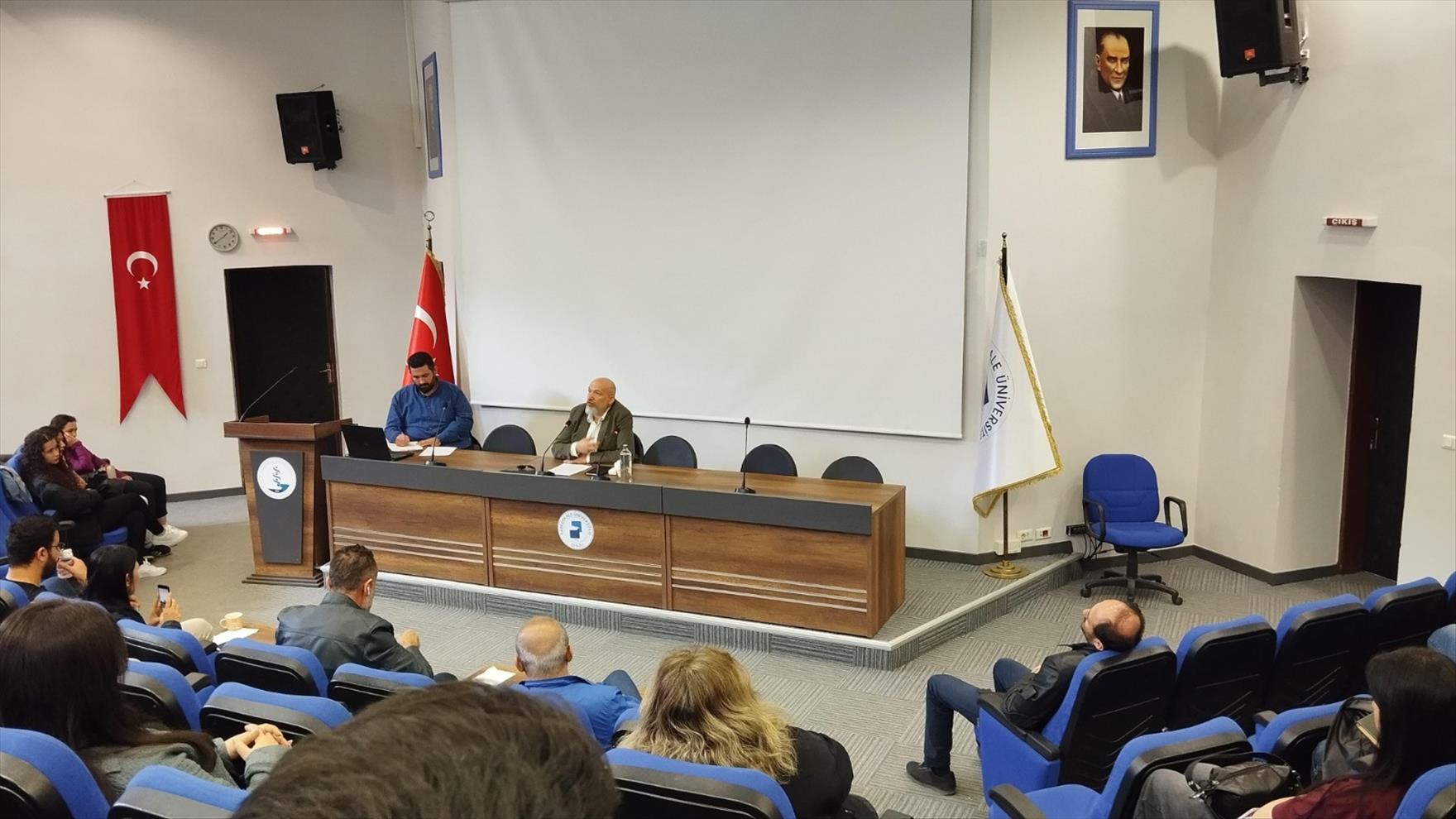
The fifth event in the “Philosophy Gatherings at Pamukkale University (PAÜ)” series, organized by the Department of Philosophy at the Faculty of Humanities and Social Sciences of Pamukkale University, took place on Wednesday, April 16, in the Prof. Dr. İsmail Çetişli Conference Hall. The event, moderated by Research Assistant Bahadır Söylemez, featured a talk by Associate Professor Dr. Ceyhun Akın Cengiz from Manisa Celal Bayar University, titled “On the Origins of the Climate Crisis: The Epic of Gilgamesh.”
Associate Professor Dr. Ceyhun Akın Cengiz began his talk by describing our time as the age of the Anthropocene and the Capitalocene. He emphasized the importance of questioning what role philosophers, academics, and intellectuals in general should play in the face of crises that arise through the dynamics of life and destruction. In this context, he stressed the necessity of confronting the concept of crisis and pointed out that such confrontation can only happen through identifying the true nature of the problem—a perspective that, he argued, also applies to understanding the climate crisis.
Dr. Cengiz highlighted that the climate crisis is fundamentally a human-made issue. While the negative aspects of such crises are apparent, he referenced the Turkish philosopher Nermi Uygur, suggesting that crises can also produce positive outcomes due to their “creative” effects within cultural contexts. Building on this idea, he examined the relevance of the Epic of Gilgamesh, known as the first written literary work.
Drawing attention to the deep connection between poetry, philosophy, and truth, Dr. Cengiz argued that the Epic of Gilgamesh offers a powerful narrative about how humanity perceives life, existence, nature, and the struggle between human beings and the natural world. He went on to discuss the epic’s core themes, which include the quest for immortality, power and authority relations, the drive toward the infinite, the tension between the civilized and the uncivilized, and the human-nature relationship.
Summarizing his arguments, Dr. Cengiz emphasized the epic’s strong connection with the concept of “culture” and underlined its importance for understanding human-to-human and human-to-nature struggles. Referring to the epic’s relevance today, he suggested that it could be seen as one of the reference points for the idea that “everything is permissible for man.” Nevertheless, he noted that culture remains closely linked both to crises and to the possibility of salvation. Dr. Cengiz concluded his speech by referencing redemptive narratives rooted in our own cultural traditions that offer hope during times of crisis.
Following the talk, audience members contributed with their questions, creating a lively discussion in the spirit of a true philosophical gathering. After the Q&A session, Professor Dr. Fatih Sultan Mehmet Öztürk, Head of the Department of Philosophy at the Faculty of Humanities and Social Sciences at Pamukkale University, presented a certificate of appreciation to Associate Professor Dr. Ceyhun Akın Cengiz. In addition, Associate Professor Dr. Alper Bilgehan Yardımcı, Chair of the Event Planning and Organization Committee of the PAÜ Philosophy Department, presented a gift to Dr. Cengiz on behalf of the department.