Structure with Dromos
The Structure with Dromos, locally known as “Pasha’s Hole”, is located in a rocky area on the southern slope of the city; it is oriented in a north-south direction and at approximately 120 m above the sea level, that is, half the height of the hill top. The closest ruins to the Pasha’s Hole are the structures called Temples A and B located at the Acropolis and approximately 250 m away. About 50 m south of the structure there is a water source still used today. The hill which Sillyon rises on, consists of a natural rocky terrain. Basically, this geological feature of the hill was exploited for the construction of the monument; the blocks used for construction were quarried and processed on site and the construction was completed. The natural rocky area selected on the southern slope of the hill was hewn out northward starting from the south and the structure was built into rocks hewn like a tunnel. Thus, a well-meditated building program based on rock-cutting and masonry construction dictated by topography emerges. Due to the geological structure of Sillyon, the structure placed among the rocks fallen in the historical process is not visible from any angle, but only when approached. No road or path leading up to this area has been attested, and an organic link was not detected with the construction of the Acropolis which is just at the north on the rocky area.
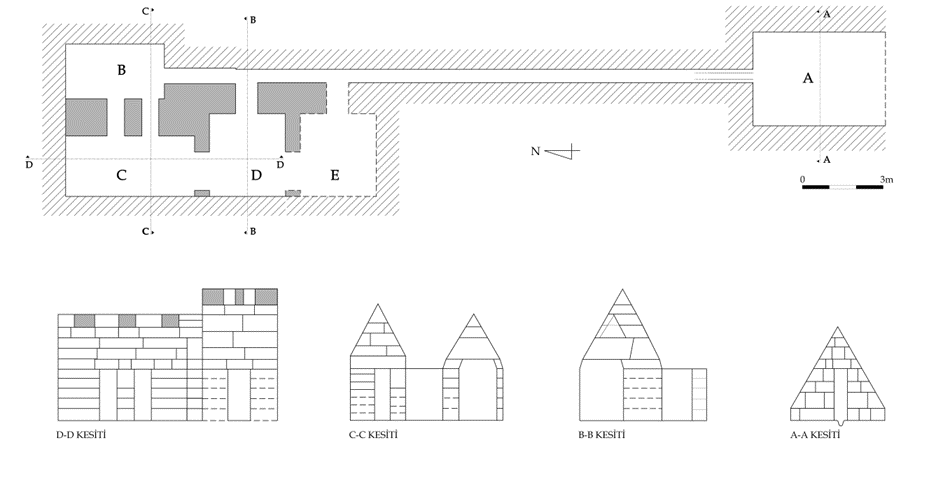
Plan of structure With Dromos
The Structure with Dromos has five rooms, named A to E, and a long dromos, i.e. corridor. The dromos has a height of 1.92 m and a width of 0.50 m; starting from room A, it extends 21.95 m in the north direction and connects to four adjacent rooms that also open to each other from the inside. The dimensions of these five rooms are different from each other and do not show any standard. The entrance to this place is in the south and the structure extends into the hill on which the city rises. No traces of any structure were noted during the survey made in this monument and its environs; thus, it stood in solitude. There is a channel at the base of the dromos and the interior of the rooms is damp with water dripping between the joints. At the end of the survey, it was understood that the water accumulating in the rooms was drained to Room A through the channel in the dromos.
Based on evidence available for the time being, it can be stated that the Structure with Dromos was built as a water structure on a water source at a steep spot far from the city; however, considering the layout and location of this water structure, it also points to a cult structure related to water. As a result of the initial evaluations, the building was dated to the Roman Imperial period and was probably used as a tomb or monument in the Late Roman – Early Byzantine period.