The PAU Faculty of Economics and Administrative Sciences hosted a Midday Seminar Series session titled "Generative Artificial Intelligence in Academia: Ethics, Responsibility, and Transformation." Held at the FEAS B Block Conference Hall, the event brought together faculty members, research assistants, and students to examine how generative AI is reshaping academic processes, its areas of application, and its ethical dimensions.
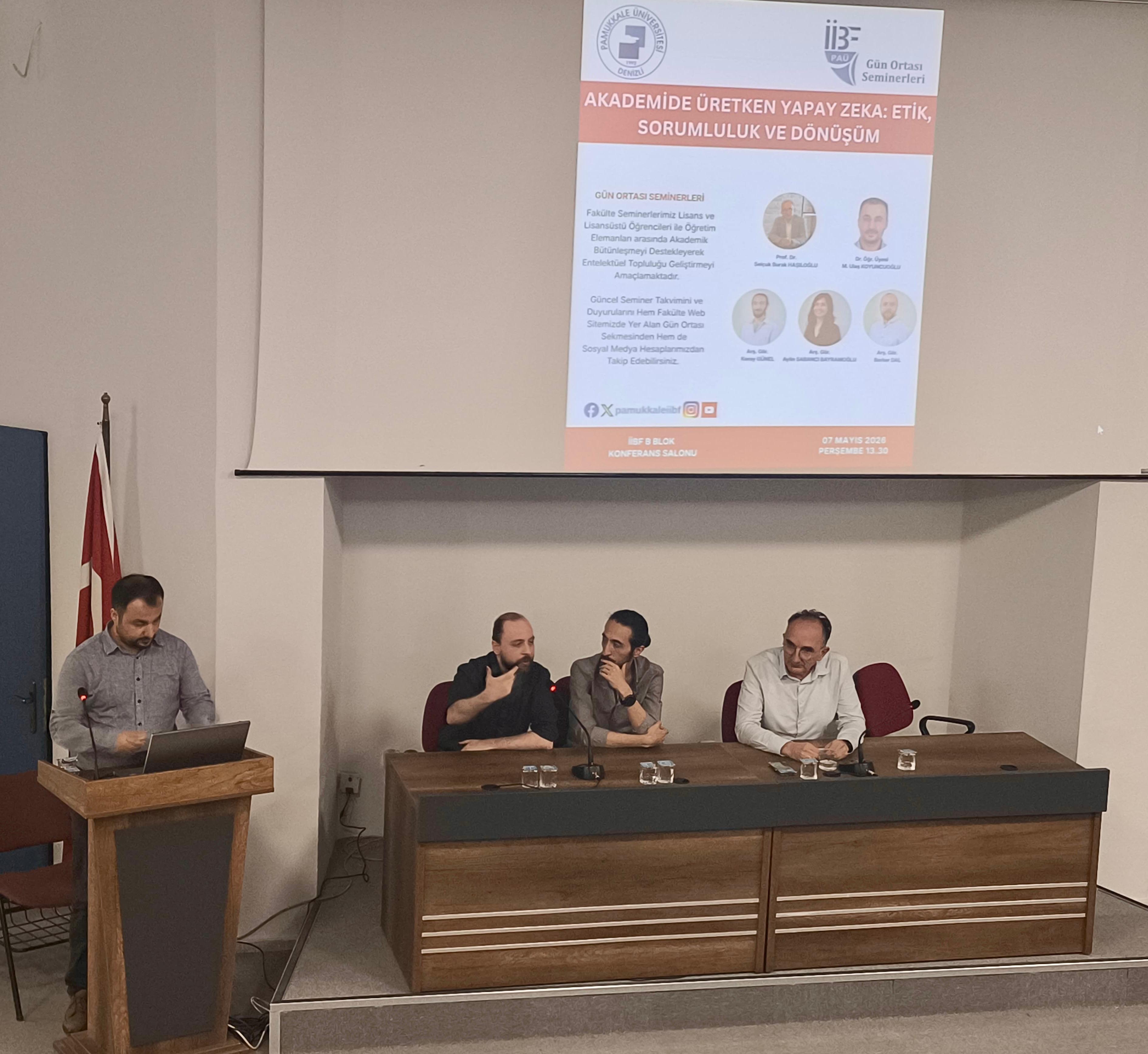
On 07.05.2026 the Midday Seminar Series at the PAU Faculty of Economics and Administrative Sciences turned its focus to generative artificial intelligence and its growing influence on academic life. The session, held at the FEAS B Block Conference Hall, featured Prof. Dr. Selçuk Burak HAŞILOĞLU and Asst. Prof. Dr. M. Ulaş KOYUNCUOĞLU, together with Research Assistants Koray GÜNEL, Aylin SABANCI BAYRAMOĞLU, and Berker DAL.
The speakers emphasized that generative AI represents more than a technological novelty; it is a transformative tool that is fundamentally reshaping academic production processes. Through concrete examples, they highlighted AI's contributions to literature reviews, data organization, translation, text development, and the overall acceleration of research workflows.
Researcher responsibility was a central theme throughout the session. While acknowledging the significant practical advantages AI offers, the speakers made clear that human oversight and researcher expertise must remain at the core of any academic process. AI should be treated as a support tool, not a co-author. The speakers also cautioned that AI systems can produce inaccurate or misleading information, and that all AI-generated outputs must therefore be critically verified. The irreplaceable role of the researcher in hypothesis development, interpretation, and scientific evaluation was underlined throughout.
The seminar's closing segment addressed ethical responsibilities in detail. Speakers stressed the importance of upholding transparency, honesty, fairness, and privacy in all AI-assisted work, and noted that clearly disclosing at which stages of research AI was used is essential for maintaining academic integrity. The session concluded with a Q&A that drew active engagement from those in attendance.