Thermoelectric (TE) enables direct conversion of heat into electrical energy with thermoelectric effects or conversely, the use of electrical energy for cooling or heating purposes. The use of thermoelectric devices to generate electrical energy is called "thermoelectric generator", and its use for heating or cooling is called "thermoelectric cooler". These devices provide these tasks only by the movement of electrons and holes, which are the material properties of the semiconductor thermoelectric materials, in the solid state. Also, thermoelectric materials have many advantages such as silent operation, compactness, simple and lightweight materials, no need for any work fluid and thermodynamic cycle while running, maintenance-free and long lifetime. For these reasons, the usage areas of these devices are becoming widespread day by day in sectors such as military, medicine, industrial applications and scientific studies, especially spacecraft. The only disadvantage of thermoelectric materials is their low efficiency and high manufacturing costs compared to other systems currently used for the same purpose. The efficiency of these materials is determined by the dimensionless ZT parameter called "figure of merit" or "thermoelectric performance coefficient".

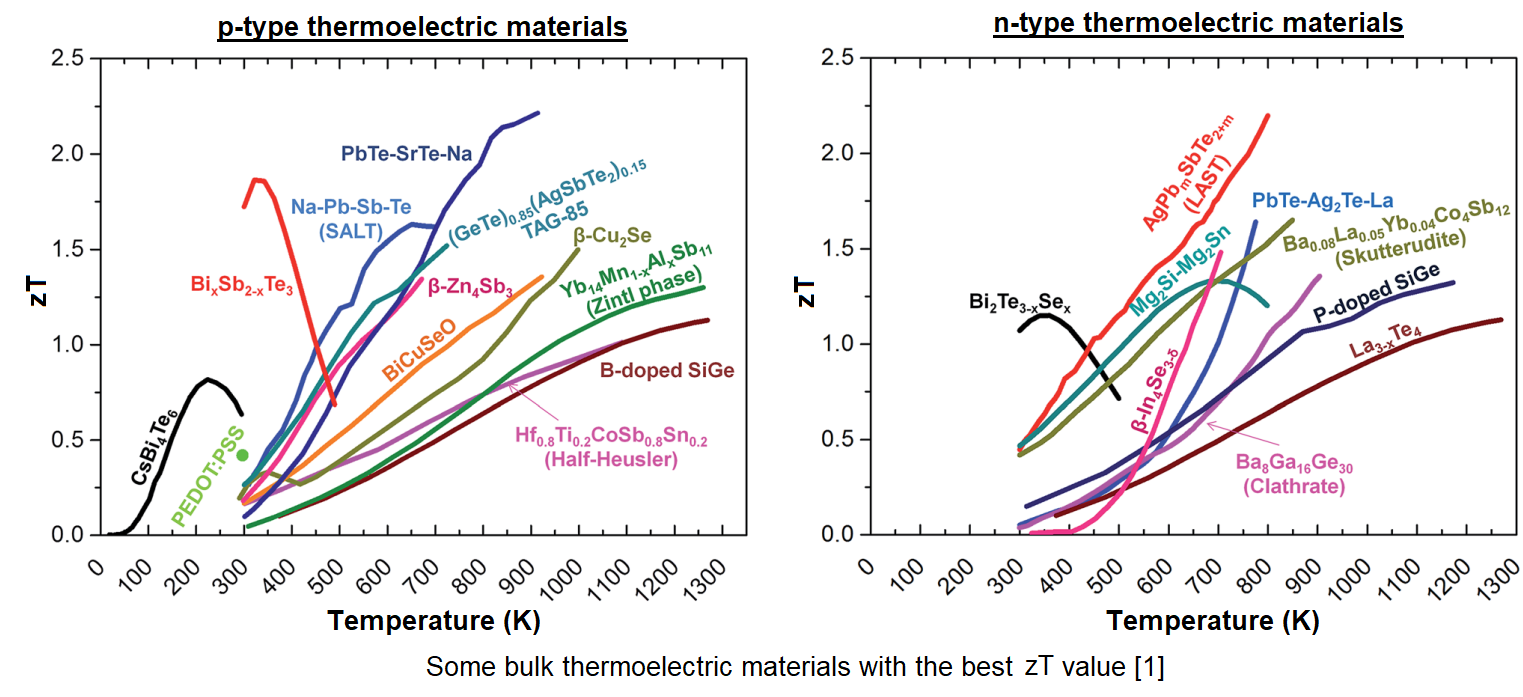
where, α: Seebeck coefficient (V/K), ρ: electrical resistivity (Ω.m), k: thermal conductivity coefficient (W/m.K), σ: electrical conductivity (S/m) and T: average temperature (K). Most of the TE devices used commercially today are based on Bi2Te3 or Sb2Te3 (Bismuth-tellurium). The ZT value of thermoelectric materials based bismuth-tellurium is approximately 1 at room temperature, and corresponding to this (ZT≈1), the efficiency of the TE device varies between 5-8%. The low efficiency of these materials compared to other systems enables scientists to focus on finding new generation TE material groups with high ZT values. Some of the bulk thermoelectric materials with the best ZT value are shown as below.
References
[1] Rull-Bravo, M., Moure, A., Fernandez, J. F. and Martin-Gonzalez, M., "Skutterudites as thermoelectric materials: revisited", The Royal Society of Chemistry, 5, 41653, 2015.