The Lykos (Çürüksu) Valley, in which Colossae is located, is one of the significant basins of Western Anatolia that has been inhabited since prehistoric times. Settlement traces in the valley have been identified dating back to the Neolithic Period; although evidence for the Middle Chalcolithic Period is limited, a marked increase in settlement density has been observed during the Late Chalcolithic Period. The strategic transitional zone in which Colossae is situated suggests continuous habitation from the Bronze Age onward. Although not definitive, it has been proposed that the city may be associated with name variants such as “Huwalušija / Hu-u-wa-lu-ša” mentioned in Hittite texts of the second millennium BCE.
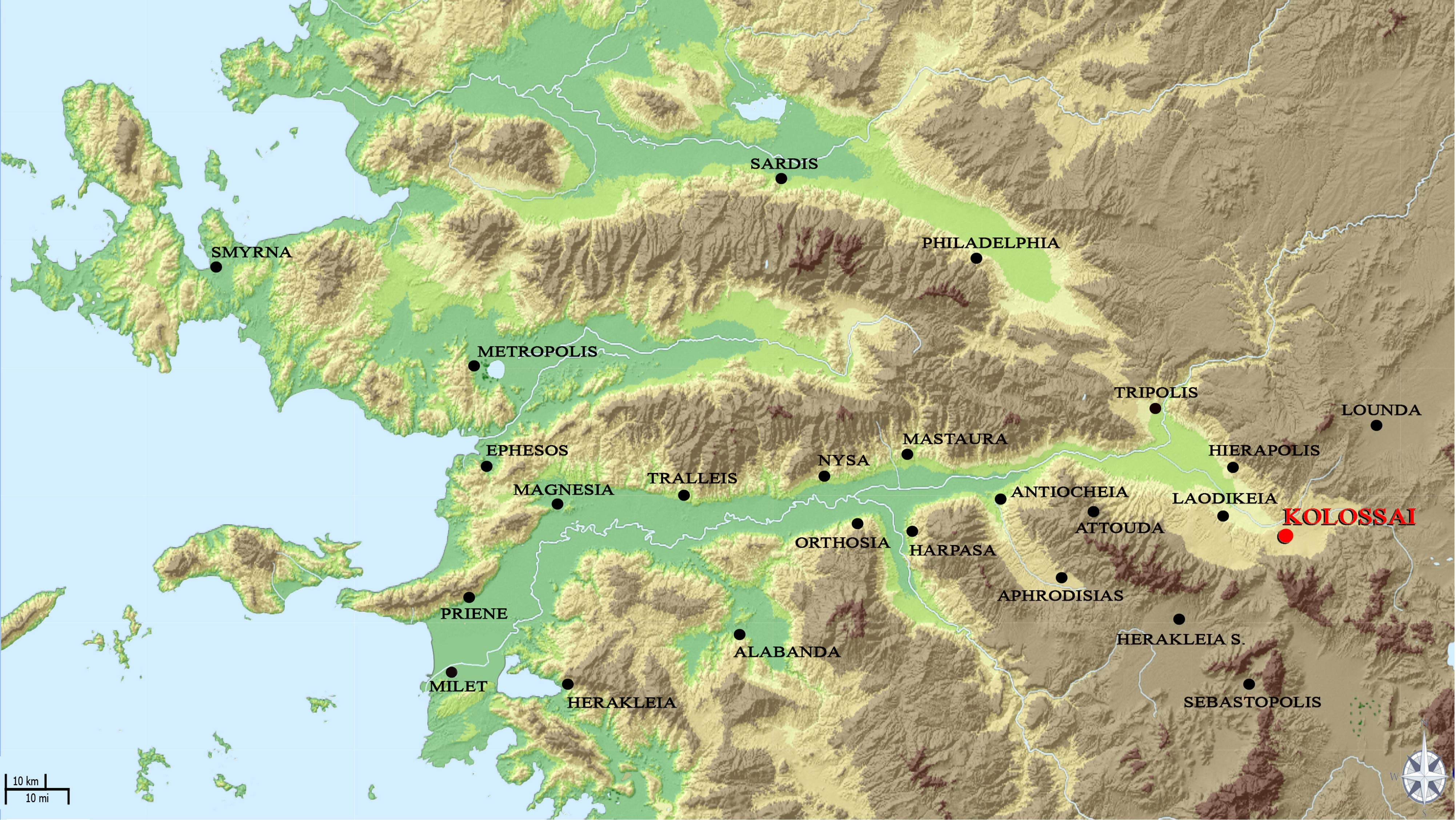
Colossae on the Map of the Maeander Valley (Map credit: B. Yener, 2025)
The name of Colossae is first explicitly mentioned in ancient literature by Herodotus. While referring to Colossae as one of the great cities of Phrygia, Herodotus recounts that during his campaign against Greece in 480 BCE, the Persian King Xerxes I (r. 486–465 BCE) passed through Anaua (Sarıkavak/Afyon), encamped at Colossae, and that the River Lykos disappeared into a chasm at this location (Hist. VII, 30). This account demonstrates that in the fifth century BCE the city was a center of both strategic and geographical significance.
Another historical event in 401 BCE further reveals the regional importance of Colossae. In the Anabasis, Xenophon records that during Cyrus’ campaign against his brother, the Persian King Artaxerxes II, the army stayed for seven days in Colossae, which he describes as a “great and prosperous city” (Anab. 1.3.7). This statement indicates that during the Classical Period the city possessed considerable economic strength and demographic vitality.
By the Hellenistic Period, however, the regional prominence of Colossae diminished relatively with the gradual rise of the newly founded cities of Laodikeia on the Lycus and Hierapolis in the Lykos Valley. Nevertheless, the city maintained its importance, particularly in relation to wool production and textile trade. Strabo notes that the black, soft-fleeced sheep raised in Laodikeia were also found in Colossae and that these animals generated significant economic revenue (Geog. XII, 8–16). Pliny the Elder further states that this wool was referred to as “colossinus,” owing to its purple hue derived from the cyclamen flower (Nat. Hist. XXI, 51).
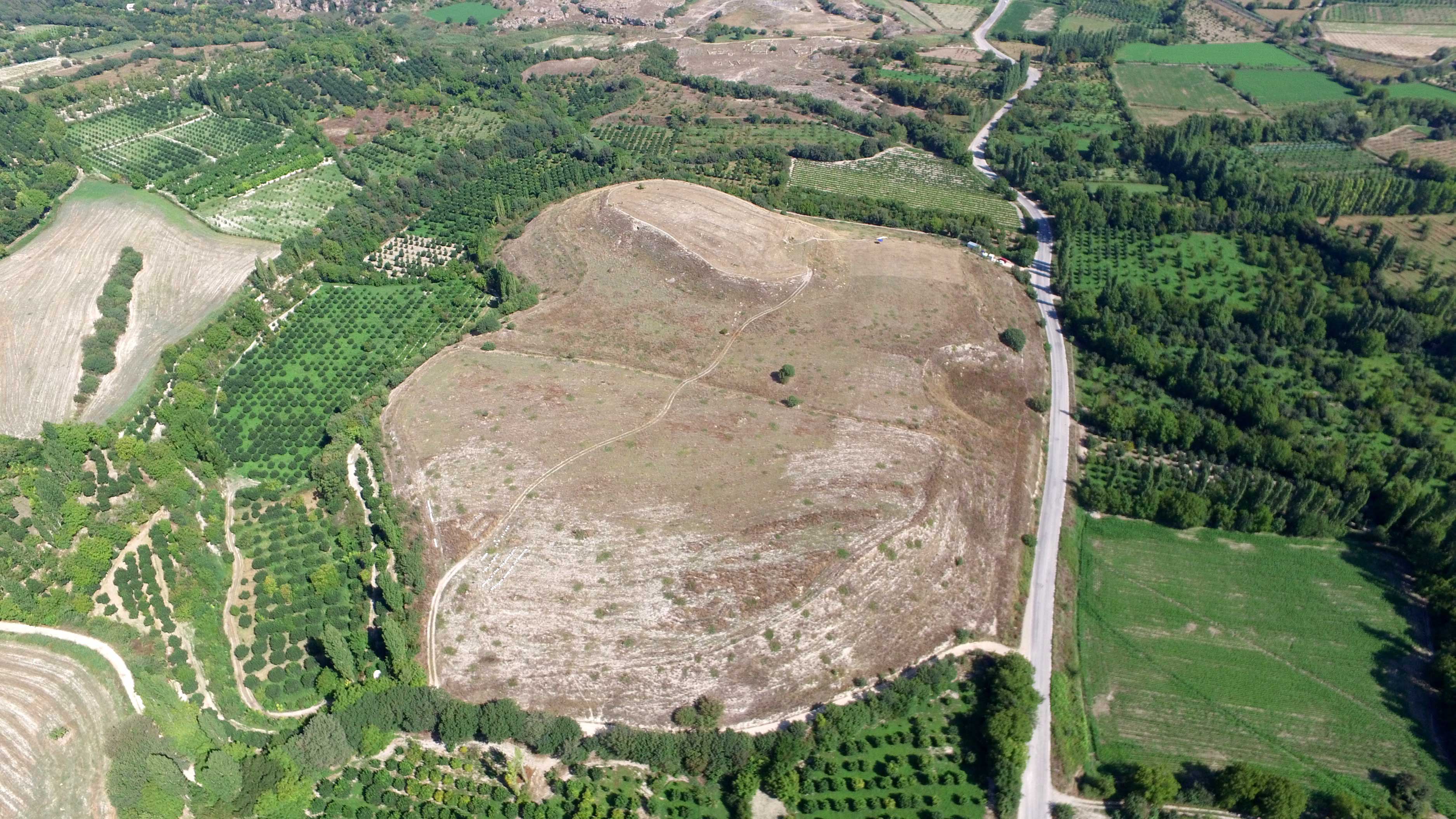 Aerial View of the Colossae Acropolis (Photo credit: Colossae Excavation Archive, 2023)
During the Roman Imperial Period, Colossae is mentioned together with the two other principal centers of the Lykos Valley. However, the great earthquake that occurred in 60 CE, during the reign of Nero, severely affected Colossae, Laodikeia on the Lycus, and Hierapolis. In the aftermath of this catastrophe, Colossae appears not to have fully regained its former prominence. Nevertheless, it is thought that during the reign of Hadrian (117–138 CE), the city entered a phase of recovery.
Because of its geographical and geological characteristics, the region was highly prone to seismic activity. Strabo notes that the Lykos River in many places flowed underground before resurfacing, indicating that the land was filled with subterranean cavities and therefore structurally susceptible to earthquakes (Geog. XII, 8–16/17). This observation represents a decisive factor for both the natural environment and the continuity of urban life.
In the first century CE, Colossae also emerged as an important center in the history of early Christianity. The Epistle addressed to the Colossians by Paul the Apostle demonstrates that the city possessed a Christian community during this period. It is generally accepted that Epaphras played an active role in the spread of Christianity in the city. This situation reveals that Colossae functioned not only as an economic hub but also as a regional religious center.
In the Late Roman and Early Byzantine periods, Colossae became particularly associated with the cult of Saint Michael. With the emergence of the Church of St. Michael in the fourth century CE, the city developed into one of the significant Christian centers of Anatolia and, under the name Khonai, attained archiepiscopal status in 858 CE.
The Arab incursions of the seventh and eighth centuries inflicted substantial damage upon the urban fabric of Colossae. During this period, it is believed that settlement shifted approximately 4 km southward to Khonai, established on the slopes of Mount Cadmus (Honaz). Furthermore, plague outbreaks during the reigns of Justinian I and Constantine V adversely affected the region’s demographic and economic structures.
In the Middle Byzantine period, Khonai maintained its importance. Under the administrative reforms of Leo VI the Wise (886–912 CE), it retained its archiepiscopal status (Ramsay 1895, 214). From 1070 onward, with the appearance of Seljuk Turkish raids in the Lykos Valley, the region became a contested zone between Byzantine and Turkish forces.
The historian Niketas Choniates of Khonai recounts that the Byzantine Emperor Manuel I Komnenos visited Khonai and the Church of St. Michael prior to the Battle of Myriokephalon (Hist. VI, 231). This narrative demonstrates that the city continued to possess religious and symbolic significance during the Middle Byzantine period.
Thus, Colossae exhibits a multilayered historical continuity extending from prehistoric settlement phases and possible Hittite references, through its regional prominence in the Classical period, its transformation during the Roman Imperial era, and its Byzantine phase as Khonai. The city’s chronology reflects a developmental trajectory parallel to the political, economic, religious, and geodynamic history of Western Anatolia.