The Christian history of Colossae can be traced through two principal phases. The first is the formation of an early Christian community in the first century CE, connected with the circle of Saint Paul. The second is the gradual consolidation, in Late Antiquity and the Byzantine period, of a sacred tradition centered on the cult of the Archangel Michael, which gained strength over time under the identity of Chonai.
The Epistle to the Colossians, associated with Saint Paul, is of particular importance in that it indicates the early spread of Christianity in Colossae through the activities of Epaphras. In this respect, Colossae was not merely a city mentioned in the New Testament, but a community center that played a meaningful role in the development of early Christianity in Anatolia.
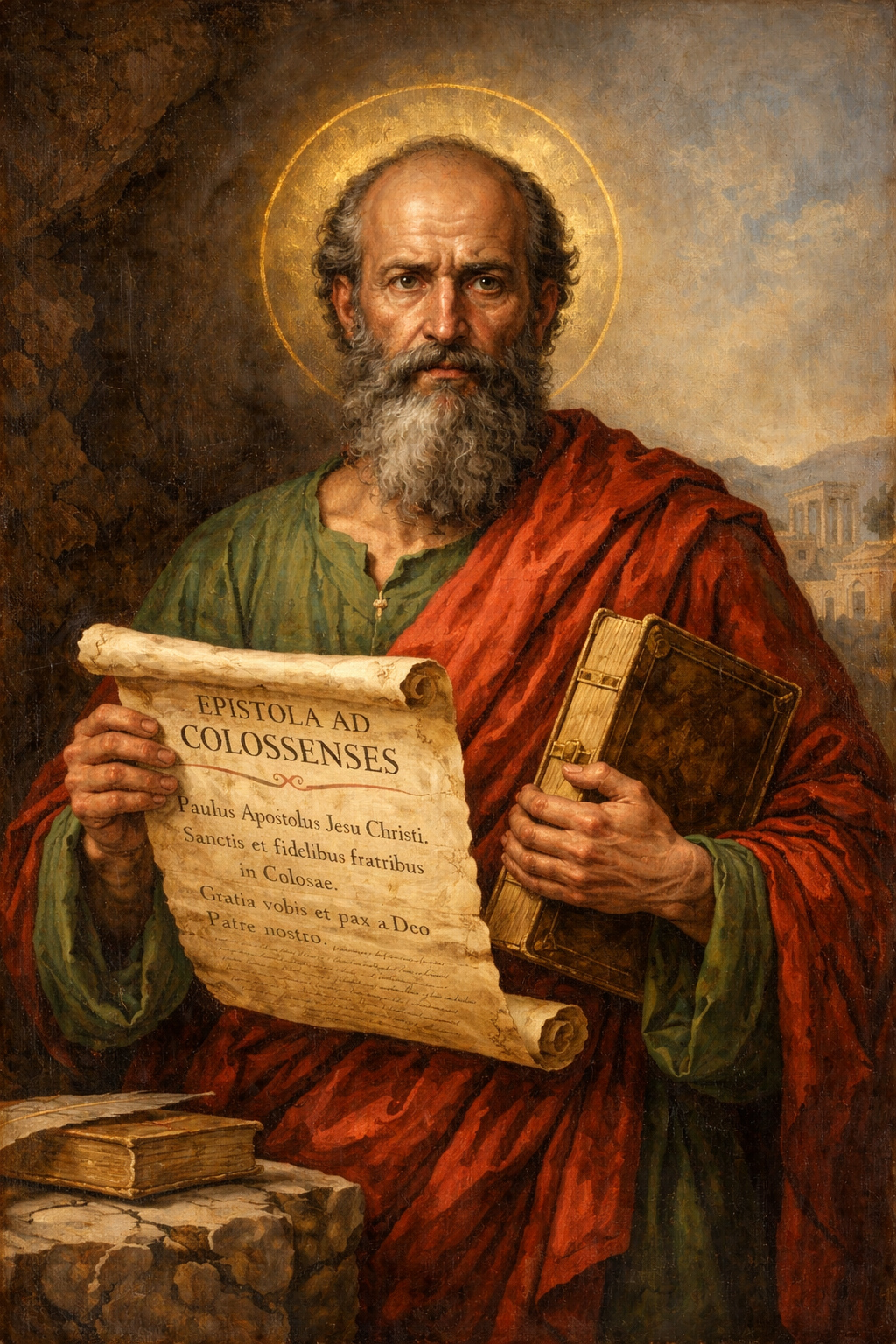 Saint Paul (AI Visual)
In the following centuries, the religious significance of the city became even more pronounced through the sacred tradition dedicated to the Archangel Michael. In the hagiographical narratives associated with Chonai, the miracles of the Archangel are depicted within a landscape characterized by rivers, valleys, healing waters, and rocky passes. The apostles are said to have arrived at a place called Chairetopa or Keretapa, where a miraculous spring emerged and healed many of the sick. Although these accounts contain certain inconsistencies, they consistently situate the sacred site immediately beside a river. This circumstance indicates that the natural environment was perceived not merely as a backdrop, but as an integral component of sanctity itself.
The portrayal of Archippus as the custodian of the sanctuary dedicated to the Archangel Michael is likewise noteworthy. This detail suggests that the tradition, over time, became institutionalized under the name Chonai and developed into a structured sacred memory. However, this does not necessarily imply that the sanctuary was originally located within the later urban center of Chonai. The topographical elements emphasized in the narrative—such as the river, gorge, fissure, and flowing water—indicate that the sacred site should more plausibly be sought in connection with the River Lykos, in the vicinity of ancient Colossae. In other words, the sacred tradition preserved under the name Chonai appears to have remained fundamentally anchored in the earlier landscape of Colossae.
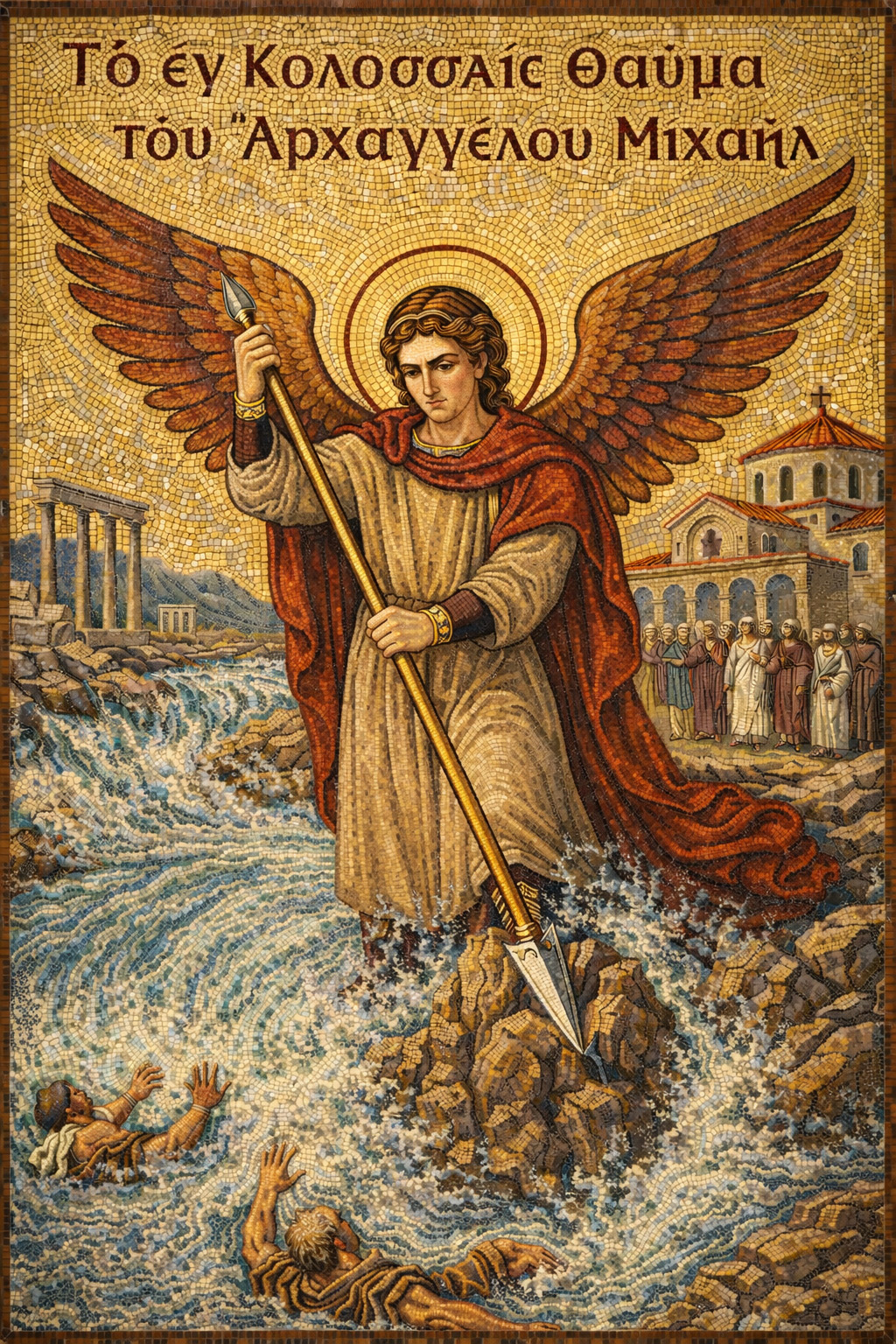 The Miracle of the Archangel Michael at Colossae (AI Visual)
These sacred narratives also reflect religious and institutional competition within the region. Neighboring centers such as Laodikeia on the Lycus and Hierapolis may have sought to exert influence over this pilgrimage-oriented sanctuary, while Colossae appears to have attempted to preserve its own religious standing. In this manner, the cult of the Archangel Michael emerged not merely as an object of devotion, but as a sphere in which regional ecclesiastical authority was negotiated and shaped.
The prominence of Chonai as the successor settlement to Colossae is likewise connected to this process. This transformation signified not simply the emergence of a new name, but the relocation of the settlement center to a more defensible area. Particularly following the Arab incursions of the seventh and eighth centuries, there was a growing tendency to shift from the exposed sections of the valley toward the more secure topography to the south. In this context, the name Colossae gradually receded, whereas Chonai gained prominence both as a settlement and as a religious identity. Its elevation to archiepiscopal status in 858 CE clearly demonstrates the institutional dimension of this transformation.
One of the most striking aspects of the Archangel Michael tradition is the manner in which the natural landscape becomes integrated into the sacred narrative. According to the legend, when enemies attempted to inundate the sanctuary, the Archangel Michael split a mass of rock and diverted the waters into a deep chasm. This account is not merely a miracle story, but also a form of memory that explains the region’s geographical features. The disappearance of the River Lykos into a fissure near Colossae was already noted in antiquity, for example by Herodotus. For this reason, the Michael tradition constitutes a powerful cultural heritage in which local geography and sacred narrative are profoundly intertwined.
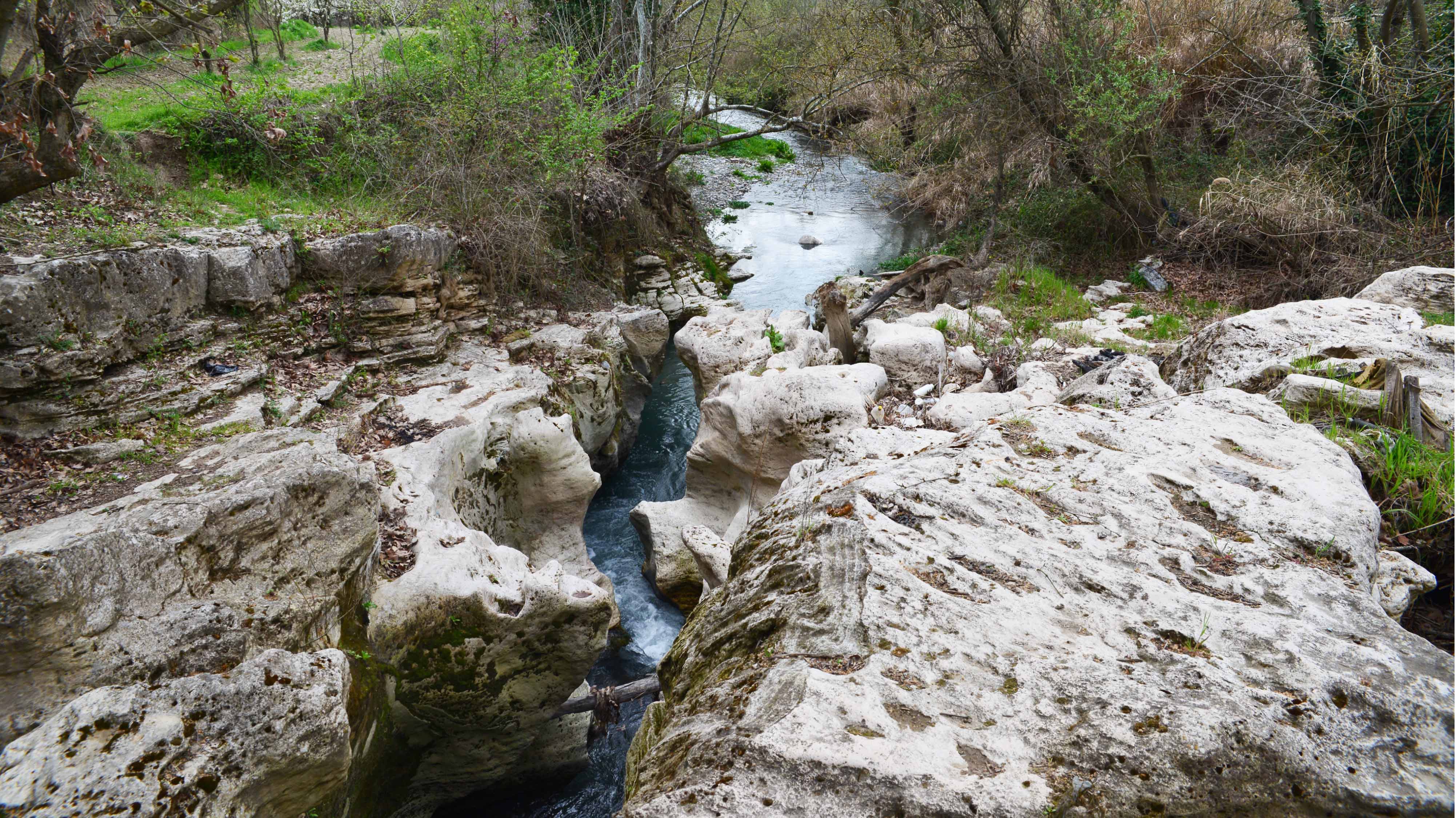
The Aksu Stream flowing beside Colossae disappears from the surface at certain points and continues its course underground (Photo credit: B. Yener, 2021).
In conclusion, the Christian history of Colossae was shaped initially by the formation of a community associated with Paul the Apostle and Epaphras in the early period, and in subsequent centuries by the sacred tradition that developed around the cult of the Archangel Michael. Although this latter phase became institutionalized under the name Chonai, its roots extend back to the landscape and sacred memory of ancient Colossae.
Thus, the Colossae–Chonai continuum reflects not merely a shift in settlement, but also demonstrates how the memory of a sacred place was preserved and reinterpreted across centuries.