HIERAPOLIS STREET
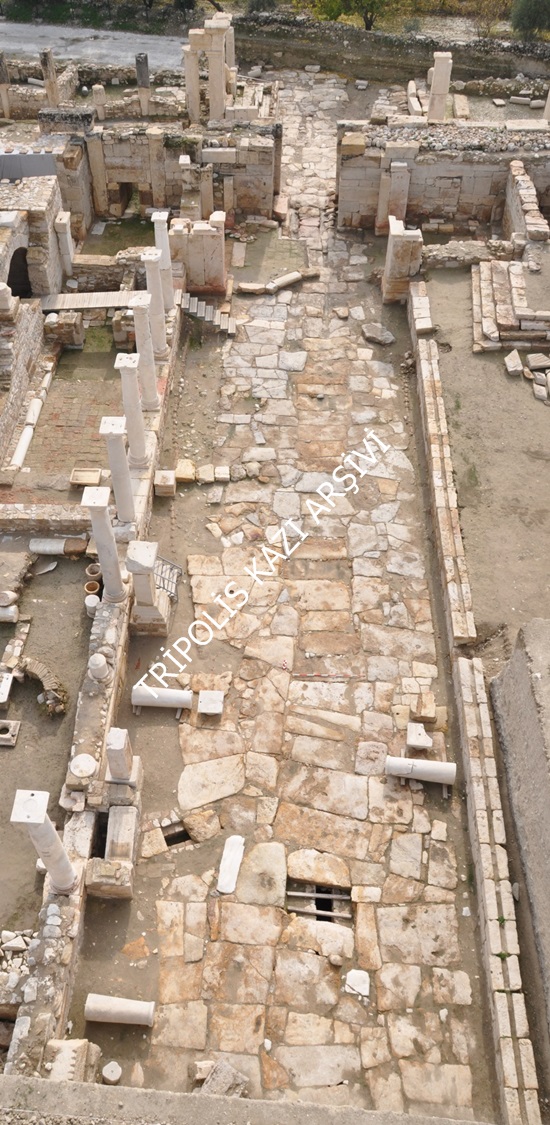
Hierapolis Street, which intersects at a right angle the east-west Colonnaded Street, was built in the Early Roman period together with it. Four travertine piers (Fig. 1) were built at the intersection of Hierapolis and Colonnaded Streets in the Roman Imperial period creating a monumental entranceto the city centre.
The fortification walls built in the end of the fourth – beginning of the fifth century AD crosses the street by the intersection. A doorway of 2.7 m width is placed in the fortification wall. The part of the street to the north of the fortification wall is 9 m wide whereas the part to its south measures 10.80 m in width. A section of 56 m in length has been uncovered to date.
Seven of the columns of the east portico of the street have been erected as part of anastylosis. The columns of white marble comprise two drums (Fig. 2).
Originally Hierapolis Street was embellished with statues (Fig. 3). With the arrangements made in the fourth-fifth centuries marble piers were erected every ca. 4.50 m in front of the columns of the east portico and statues were put up on them (Fig. 4 ). Some of these statues depicting the city’s magistrates have been uncovered and currently are on display at Denizli Archaeological Museum.
There is a small pool on the east side of the street.
It was built to regulate the pressure of the water coming from a structure to
the east of the portico. Thus, in case of sudden pressure rises pressurised
water was discharged into the main sewage channel under the street via a
channel under the pool without causing damage to the street and the portico.